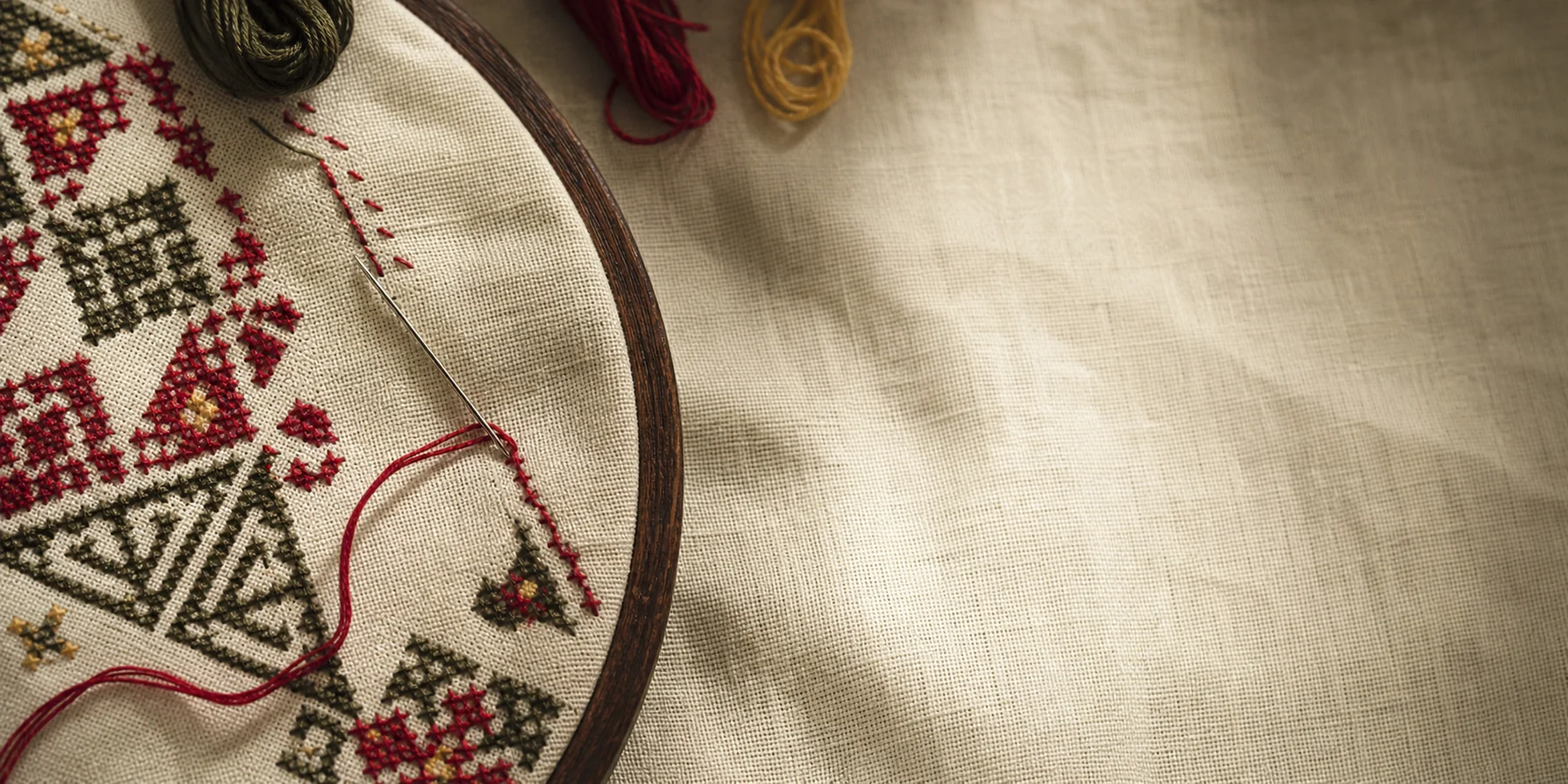
A visual guide to stitches, motifs, cloth, colour and embroidery placement in the dress traditions of Gaza and its district.
Documented records
8
Dress placements
3
Scope
Gaza area
Thread as a memory of place.
The language of embroidery
What do we mean by derza?
In everyday speech, derza may refer to either the stitch itself or the full motif. Here the terms are separated: stitch is the thread technique, motif is the form, composition is the arrangement of forms, and placement is their position on the dress.
Visual glossary
A guide to Gaza embroidery
Eight entries explain technique, motif, cloth, colour and composition in Gaza-area embroidery.
01Stitch & technique
Fallahi cross-stitch
Core technique
A counted-thread cross-stitch used across central and southern Palestine. It builds the geometric and vegetal units that shape the embroidered fields of the dress.
Gaza’s character emerges through the meeting of technique, composition, colour and cloth.
02Stitch & technique
Akeedeh joining stitch
Gaza-area joining stitch
A blue-and-red joining stitch used on abu mitayn cloth woven in Majdal. It joins sections of cloth while turning the seam itself into a visual element of Gaza-area dress.
03Motif
Gaza qilada
Representative area motif
The qilada, or pendant, is a representative Gaza-area motif built as a suspended form within an embroidered unit and expressed through several variations.
04Colour
Gaza magenta
Colour identity
Gaza-area pieces are distinguished by magenta and fuchsia tones. Colour works with the structure of the motif and the cloth to create a clear regional character.
05Composition
Isdud large-unit composition
Arrangement method
Isdud embroidery arranges patterns in large units, making the embroidered field read as clear blocks with rhythm and symmetry.
06Textile
Majdalawi cloth
Ground cloth
Majdal was a weaving centre whose fabrics became known as majdalawi and were used for Palestinian village dress. Gaza embroidery is therefore read through its ground cloth as well as its thread.
07Textile
Abu mitayn cloth
Majdal-woven textile
Abu mitayn is a Majdal-woven cloth carrying the blue-and-red akeedeh joining stitch, bringing textile making and seam decoration together in Gaza-area dress.
08Textile
Janna wa Nar
Named striped cloth
A Gaza cloth named for its green and magenta stripes, reflecting a local practice of naming textiles after the colours of their silk bands.
Dress map
Where does the embroidery sit?
The Gaza chapter organises samples by placement. These site diagrams are original and do not reproduce the book’s plates.
Dress placement
Chest and qabbeh
Chest compositions are built around the neckline, often arranged on a central axis that balances both sides of the qabbeh.
Dress placement
Side panels and banayek
Vertical panels carry sequences of geometric and vegetal units along the sides of the dress; their arrangement creates the piece’s rhythm and character.
Dress placement
Back panel
The back uses larger units or stacked bands read from top to bottom, revealing rhythm and symmetry across Gaza-area dresses.
Chapter scope
Places in Gaza’s textile memory
These places appear together in the textile and dress history of Gaza’s cultural region.
Gazaغزة
Majdalالمجدل
Isdudإسدود
Hamamaحمامة
Kawkabaكوكبا
Beit Lahyaبيت لاهية
Jabalyaجباليا
About the reference
A book preserving the language of stitch
Book
Palestinian Embroidery: Traditional “Fallahi” Cross-Stitch
Focus
Palestinian embroidery techniques, textiles and compositions
Edition
Special revised edition, copyright 2021
The site offers a concise reading of Gaza embroidery while preserving the book as a reference for research and learning.